You don’t need a faster car. You need to learn how to drive the one you already have.
Right now, most organizations aren’t set up to handle AI. They’re stuck.
This is the third article in the series: “Speed Requires Stewardship”; here, we are building on Jason Blake’s last article and digging into where organizations actually are in their AI maturity.
You Bought the Car. You’re Not Racing It.
At this point, most organizations have access to powerful AI. The tools are there. The capability is real.
It’s like being handed the keys to a Formula 1 car.
And then…
Driving it like you’re stuck in traffic.
Careful. Controlled. Not because that’s what the car is built for – but because the system around you isn’t ready for anything else. The problem isn’t that organizations are behind on AI.
It’s that they’re not set up to operate it.
The Illusion of Progress
At first, it feels like momentum.
Teams experiment.
Tasks get faster.
People start relying on AI.
It looks like transformation.
But it isn’t.
Because underneath all of it, nothing fundamental has changed. Same workflows. Same decision structures. Same fragmentation.
AI is just sitting on top. Making things faster.. but not better.
Where Most Organizations Actually Are
In racing, there’s a difference between:
- Having a fast car, and
- Knowing how to drive it
Most organizations are stuck right in between. They’ve upgraded the machine, but not the system around it. This isn’t random.
It’s a progression.
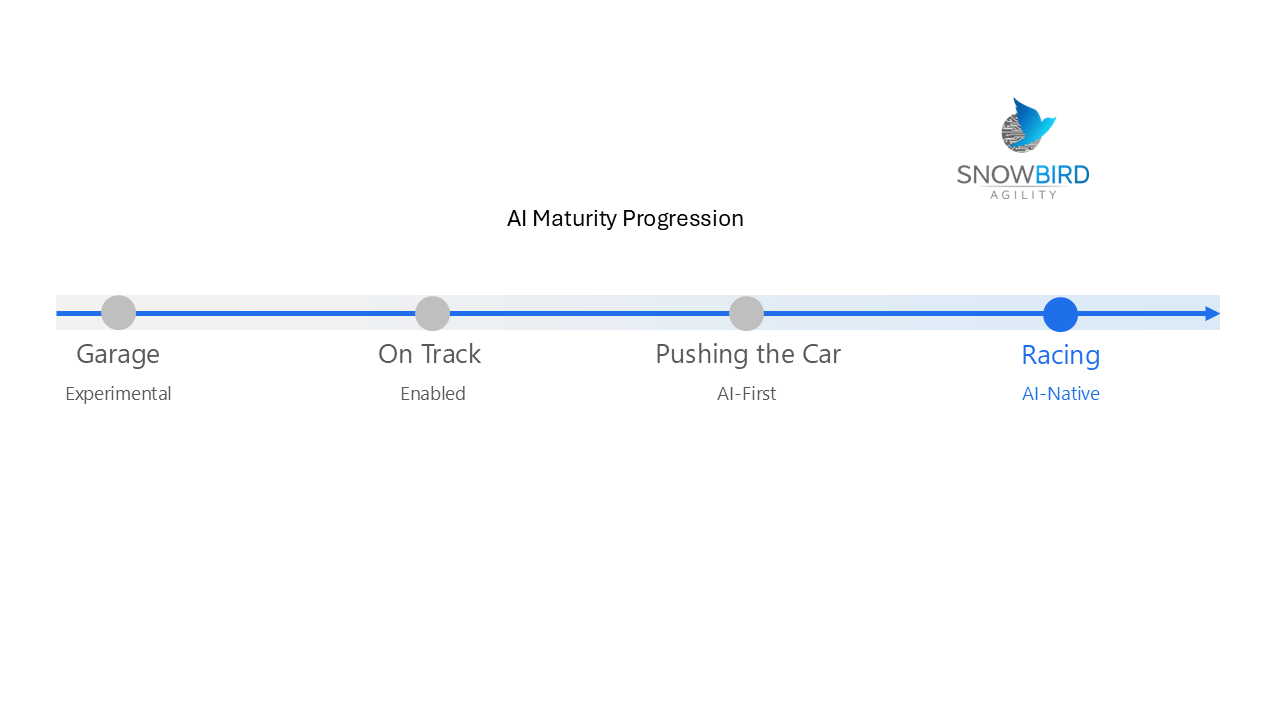
Most organizations move through the same stages whether they realize it or not. You can think of it as a maturity ladder.
But in practice it looks more like this:
Stage 1: In the Garage
You’re testing what the car can do – trying tools, running experiments, and figuring out where it might help. There’s energy, but no consistency. Nothing scales.
Stage 2: On the Track – Playing It Safe
This is where most organizations are.
You’re on the track now. AI is part of real work, productivity improves, and teams begin to depend on it
But you’re still operating like you’re in traffic.
Because everything around you assumes the old way of working, so instead of pushing the system forward, you stay within familiar patterns, keep AI in a supporting role, and avoid anything that feels misaligned or unclear
It works.
But the system itself hasn’t evolved.
Stage 3: Pushing the Car
This is where things start to change – and where most organizations hesitate.
You begin redesigning how work actually happens. AI informs decisions from the start, workflows adapt to intelligence, and trust begins to build.
This requires letting go of how things used to work. Not completely, but enough to move differently. Most organizations don’t stall here because they can’t. They stall because they’re not set up to.
Stage 4: Racing
At this point everything aligns.
The car, the driver, and the system are working together. Decisions are fast and informed, workflows are built for how intelligence actually operates, and humans and AI function as a coordinated system.
You’re not longer “using AI.” You’re operating with it.
This is what AI-Native actually looks like.
Why Organizations Stay in First Gear
It’s not a technology problem. It’s an operating model problem.
Organizations get stuck because AI is owned in silos, there are no clear guardrails, trust is inconsistent, and decision-making is still bottlenecked.
So progress fragments. And eventually… it slows.
This Is Where Stewardship Actually Matters
In racing, safety isn’t separate from performance. It’s what makes performance possible.
The same is true for AI.
Responsible AI isn’t about slowing things down. It’s what allows organizations to move forward without hesitation. Early on, it prevents chaos. In the middle, it creates consistency. At scale, it becomes infrastructure. Without it, organizations stay constrained. With it, they can actually operate as intended.
The Real Shift
This isn’t about adopting better tools.
It’s about learning how to operate differently.
Because right now, most organizations have the car, have the track, and have the opportunity..
..but are still structured like they’re in traffic.
What Comes Next
Recognizing where you are is uncomfortable, but necessary.
The next step is understanding what capabilities actually define each stage, where the gaps are, and how to move forward intentionally.
Because success with AI isn’t about how quickly you adopt it.
It’s about whether your organization is actually built to operate with it.
Dan Foster has more than 25 years of experience in information technology and services, specializing in business agility transformation, Lean-Agile frameworks, and AI-enabled operating models. As a Transformation Leader at Snowbird Agility, Inc., he partners with executives, portfolios, and delivery teams to implement SAFe®, align strategy to execution, and improve flow, predictability, and measurable outcomes.
He may be reached at [email protected]
View the AI Maturity Progression Model here
 Tom Munro
 Mike Kleiman